Powered roller conveyors were initially adopted abroad, where their development progressed relatively rapidly. With the advancement and continuous improvement of computer technology, communication technology, operational techniques, and testing methods, as well as their widespread application, the development of electric roller conveyors has entered an era of diversification. Powered roller conveyors encompass numerous types, such as tubular belt-driven roller conveyors, steep-angle belt conveyors, and curved belt conveyors. Although domestic development started later, it has not fallen behind. Significant achievements have been made in roller conveyor advancement, including new technologies and products. For instance, the development of elastic belt conveyors, large-angle and long-distance belt conveyors, and the use of programmable controllers have greatly propelled the advancement of powered roller conveyor technology and provided guidance for its development.
For underground electric roller conveyors, most now employ underground electric roller conveyor control systems to achieve real-time monitoring. The control systems for underground powered roller conveyors are extensively employed in material excavation and transportation, featuring an ideal automated system. Integrating modern information and communication capabilities, these systems not only ensure smooth underground operations but also enhance output capacity and deliver outstanding economic management benefits. Simultaneously, the application of mechanical automation control effectively guarantees efficient construction progress, reduces production and management intensity, and offers excellent reliability and advanced functionality.
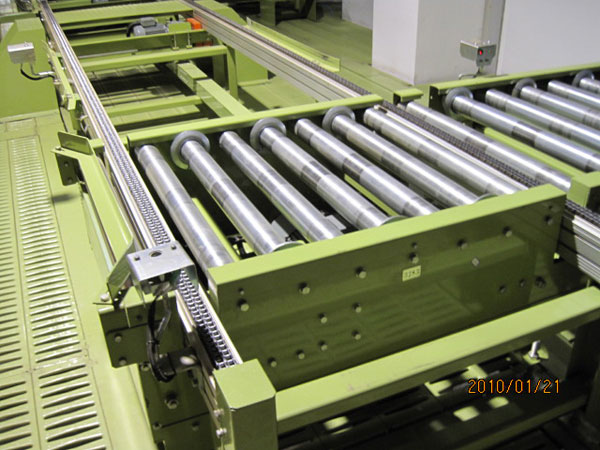
Roller Conveyor
I. Composition and Technical Parameters of the Powered Roller Conveyor Control System
Regarding the overall system structure, the powered roller conveyor control system comprises hardware and software components. The hardware system primarily includes the master station and slave stations along with their accessories (electromagnetic starters, controllers, displays, detectors, transmission cables, etc.); The software system primarily refers to the entire information communication and processing system, namely the application of control software programs.
The PLC serves as the core of the upper-level control system. Typically, each powered roller conveyor within the transportation system is equipped with a programmable control cabinet. This cabinet handles the detailed operation of the powered roller conveyors within the station and provides real-time monitoring of substation units. There are numerous types of PLCs. Currently, PLC programmable controllers are commonly employed, with multiple PLCs forming a data transmission network to achieve control over different plans and functions. Each manipulator is equipped with a detection program that collects information on unit operation and running status, then feeds it back to the manipulator. The primary purpose of the display unit is to provide operators with control information such as system operating status, key parameters, belt running status, detected operational conditions, and fault information.
Technical parameters for powered roller conveyor control technology primarily refer to key system parameters, along with supplementary specifications like input voltage, DC operating voltage, industrial control panel voltage, audio-visual speaker voltage, input signals, and output signals. Parameters are typically determined based on actual production requirements, with appropriate systems selected accordingly.
II. Functions and Characteristics of Powered Roller Conveyor Control Systems
1. Automation of Powered Roller Conveyor Control. Automation is primarily reflected in the selection of system controllers and remote monitoring capabilities. Operators at the main station can remotely access and control each substation through the information management system at the operator station, while collecting and processing data. This facilitates timely information handling, thereby enhancing system stability.
2. Self-Diagnostic Fault Detection for Powered Roller Conveyors. The system network, PLC programmable controllers, and sensors possess self-diagnostic capabilities. When network disconnections, control module failures, or signal transmission interference occur, the system issues corresponding alarms.
3. Decentralized Structure of the Powered Roller Conveyor. The system adopts a distributed architecture with “surface control as primary, underground control as secondary.” The main unit and sub-units are interconnected without mutual interference. Even if surface components fail, underground units continue operating normally, thereby enhancing system reliability.
4. The powered roller conveyor features user-friendly operation. The system control interface is rational and universal. By simulating actual operational scenarios, the screen displays vivid, intuitive, and well-organized information, facilitating easy identification and control by operators. Functional settings are comprehensive, including operational status display, test data reporting, and fault alerts.
5. The powered roller conveyor has low operating costs. Long-distance distributed control reduces unit wiring and saves costs. The system's stability, reliability, excellent scalability, and high network flexibility allow functional upgrades through software modifications without requiring complete redesign.
6. Low maintenance costs for powered roller conveyors. The system's inherent reliability, combined with its self-diagnostic capabilities, minimizes system failures and reduces maintenance expenses.